Bedding · Natural fibers · Care guide
How to Choose an Alpaca Wool Pillow: Fill, Loft, and Care
A pillow is a small landscape with unusually high stakes. It has to meet the head at the right height, yield without collapsing, and remain comfortable through the night. Alpaca and wool offer one route to that balance, but the fiber name alone cannot tell you how a pillow will feel. Fill construction, loft, casing, and care all have their say.
Start with the shape of your sleep
Choosing a pillow can seem like a matter of taste until the night begins. A pillow that feels inviting in a shop may be too high once you lie down; one that seems pleasantly soft may flatten under the weight of your head. The useful question is not simply whether alpaca is soft, warm, or natural. It is whether the pillow’s particular construction suits the way you sleep.
Sleep position offers a practical starting point. Side sleepers generally need enough height to fill the space between the shoulder and the head, keeping the neck from angling downward. Back sleepers often prefer a medium profile that supports the natural curve of the neck without pushing the chin toward the chest. Stomach sleepers commonly find a lower, more yielding pillow less strenuous, though comfort and individual anatomy vary. These are starting points, not rules: shoulder width, mattress firmness, and personal preference change the equation.
Think, too, about what you mean by “support.” Some people want a pillow that holds its form; others want one that compresses readily and feels less structured. A natural-fiber label cannot settle that difference. Ask what the pillow is filled with, how the fill is arranged, and whether its height is adjustable. If a description does not say whether the fill is loose, layered, or enclosed in compartments, it may be worth asking the maker before deciding.
A pillow is also not a mattress topper or a comforter in miniature. Materials that feel pleasant in a blanket can behave differently when concentrated beneath the head. For a pillow, the relevant measures are chiefly loft, resilience, surface feel, and the ability to keep its shape through ordinary use.
What alpaca and wool bring to a pillow
Alpaca fiber is valued for its soft hand and insulating character. Wool, used on its own or in a blend, is also known for its spring and capacity to manage moisture. In bedding, these natural fibers can offer a breathable alternative to some synthetic fills. But “natural” does not mean uniform: the feel depends on fiber quality, processing, fill density, and the way the pillow is assembled.
Descriptions often use the phrase alpaca and wool pillow as if it named a single standardized object. It does not. One pillow might contain alpaca fiber with wool batting; another may use a blend, a layered fill, or a casing that substantially changes the way the surface feels. A label listing both fibers is useful, but it is only the beginning. Look for percentages where available, and distinguish the material in the fill from the material in the outer fabric.
Wool’s natural crimp contributes to its springiness, while alpaca is often described as comparatively smooth and light. In a finished pillow, those broad fiber characteristics meet the decisions of a manufacturer: how densely the fill is packed, whether it is stitched into chambers, and how much room it has to shift. Those construction details can matter more to perceived firmness than the headline fiber name.
Claims such as “hypoallergenic” should also be read with care. Some people find that natural fibers work well for them; others may be sensitive to a fiber, its processing, dust, or the materials in its casing. No material is guaranteed to suit every sleeper. If allergies or skin sensitivity are a concern, check the full material information, consider using a washable protective cover, and follow any advice from a qualified health professional.
Loft, firmness, and the quiet geometry of comfort
Loft is the pillow’s height when it is resting, but the number can be misleading unless you know how the pillow behaves under pressure. A lofty pillow may compress substantially when you lie on it. A lower one may feel surprisingly firm if its fill is dense and resilient. When possible, assess both the pillow’s uncompressed profile and its response to pressure.
A useful test is to notice whether your head settles into the pillow while the neck remains supported. You should not have to prop your arm beneath your head to make up for a pillow that is too low, nor feel your head tipping forward or sideways because the pillow is too tall. If you share a bed, remember that the same pillow can feel different on mattresses with different firmness levels. A softer mattress lets the shoulder sink farther, changing the gap the pillow must fill.
For a pillow with loose fill, investigate whether the amount can be adjusted. An opening that allows fill to be removed or added can make it easier to fine-tune the height, though it also calls for careful handling and a secure closure. A fixed-fill pillow is simpler, but its loft is a more consequential commitment. Ask about dimensions, firmness, and return arrangements rather than relying on a photograph or a label such as “medium.”
- Side sleeping: look for enough height to support the head without tilting it, taking shoulder width and mattress softness into account.
- Back sleeping: consider a moderate profile that supports the neck without lifting the head excessively.
- Stomach sleeping: a lower, softer feel may be more comfortable for some people; avoid assuming that extra loft means extra support.
- Changing positions: a middle-ground height or adjustable fill may be easier to live with than a pillow designed for only one posture.
These distinctions are not a diagnosis or a promise of better sleep. Persistent neck pain, numbness, or other symptoms deserve more than a change of bedding. A pillow can influence comfort, but it is not a substitute for medical advice.
The casing is part of the pillow
The outer fabric is the first thing the face encounters, and it helps determine how a pillow breathes, moves, and holds its fill. Cotton is a common casing material because it is familiar, washable in many constructions, and available in a range of weaves. A tightly woven cover may help keep fine fill contained; a softer or more textured fabric may alter the surface feel. Seams and closures matter, too. A well-made casing should hold the filling evenly and close securely.
Carefully separate the casing from the pillow itself when reading a product description. “Organic cotton cover,” for example, says something about the shell, not necessarily the fiber inside. Certifications apply to particular materials or stages of production, not automatically to every component or every claim a product might make. Read the scope of a certification and the stated fiber percentages rather than treating a seal as a catch-all assurance.
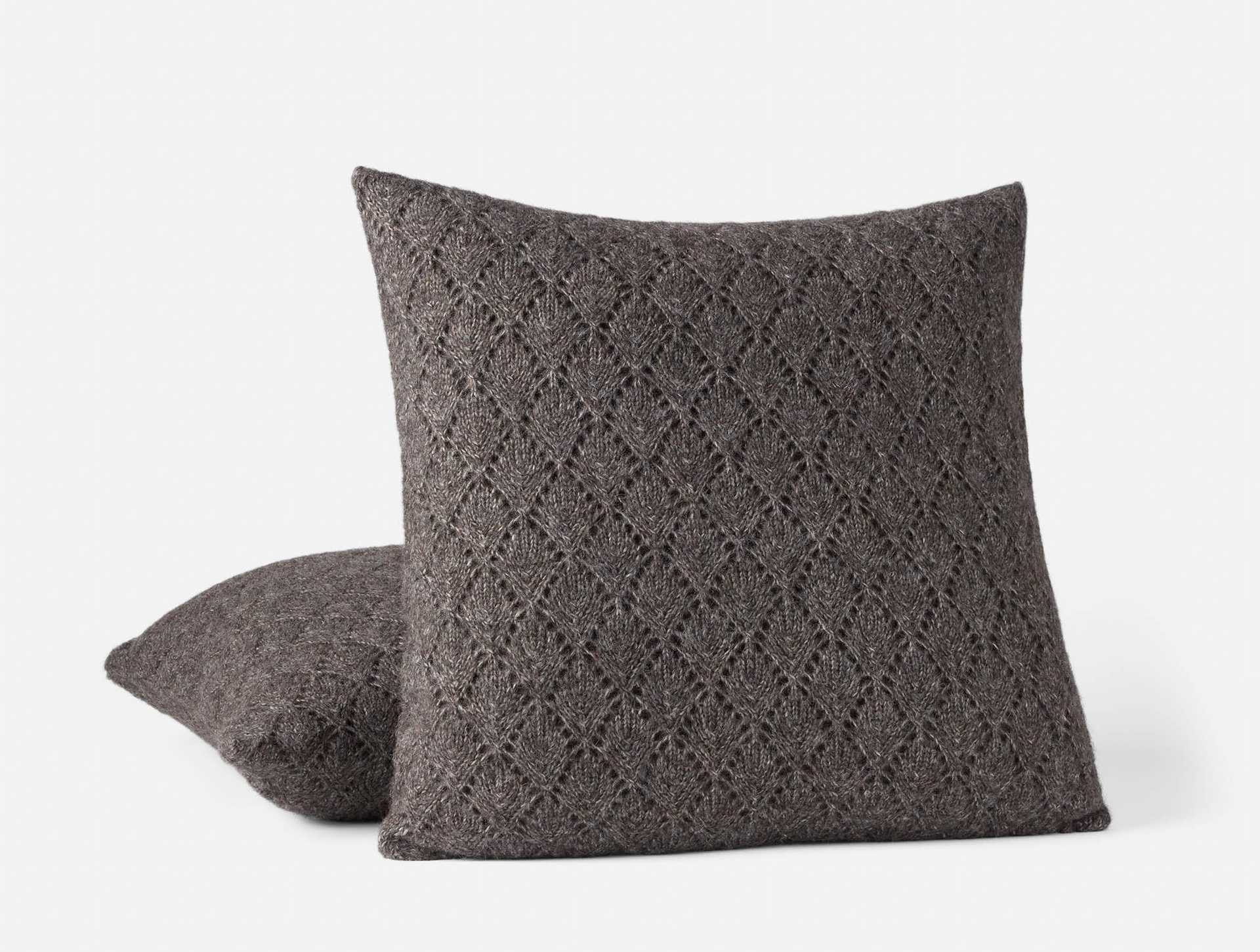
A decorative pillow cover is not a sleeping pillow. The distinction sounds obvious, but product pages can blur it when they describe softness, filling, or support in adjacent categories. The Paracas Alpaca Cotton Knit Decorative Pillow Cover, for instance, is a cover, not a filled sleep pillow. Its listed materials are 56 percent alpaca and 44 percent organic Pima cotton, with a baby-alpaca lining; the insert is sold separately. It has an openwork knit, an invisible zipper, and care instructions calling for a cold, gentle machine wash and low tumble drying. Those details make it an interesting example of how fiber content and construction shape a cover’s character, but they do not tell you what an alpaca wool pillow’s internal fill or sleeping loft will be.
That distinction matters when shopping: a cover can change the surface and appearance of a pillow, while the insert determines much of its height and support. Check the dimensions of both. A mismatched insert may pull a cover taut or leave it slack, and neither outcome is likely to improve the experience.
Care begins with the label
Natural-fiber pillows are not all washed in the same way. Some may be spot-cleaned; others may require professional laundering or a removable, washable cover. Water, agitation, heat, and unsuitable detergent can affect fibers, seams, and shape. The safest instruction is the one supplied for the specific pillow, not a general rule borrowed from a wool sweater or a cotton sheet.
Before cleaning, identify which part needs attention. If the pillow has a removable protector or outer cover, laundering that piece may be preferable to wetting the filled core. For a small mark, use the least aggressive method permitted by the care label. Avoid soaking a densely filled pillow unless the maker explicitly allows it: a damp interior can dry slowly, and moisture left inside may cause odor or other problems.
When a label calls for professional laundering, do not assume that dry cleaning is interchangeable with washing. The distinction can matter for fiber and construction. If the instructions are unclear, contact the manufacturer or retailer and ask for the recommended service by name. For any home laundering, follow the stated water temperature, cycle, detergent, and drying guidance closely. Excessive heat can shrink or distort some natural fibers; fabric softener and bleach may also be unsuitable.
Routine care is gentler than rescue. Use a pillow protector beneath the pillowcase, wash the pillowcase regularly, and let the pillow air in a dry, well-ventilated place when needed. Follow the manufacturer’s guidance about sunlight and fresh air rather than leaving a natural-fiber pillow in strong sun for long periods. Avoid folding or compressing it for extended storage if doing so would strain the fill or seams.
Fluffing can help redistribute loose fill and restore an even surface. Use a gentle motion and check the label before putting a pillow in a dryer, even on a low setting. Some products tolerate machine drying; others do not. A care routine should preserve the pillow’s structure, not turn its maintenance into an experiment.
Questions worth asking before you choose
Product language tends to celebrate softness and warmth. For a sleep pillow, the more useful details are often less glamorous: what is inside, how much of it there is, and what happens when it is compressed. A few direct questions can make a comparison more meaningful.
- Is the fill alpaca, wool, or a blend, and are the proportions disclosed?
- Is the fill adjustable, compartmentalized, or fixed in place?
- What are the pillow’s dimensions, loft, and stated firmness?
- What is the casing made from, and can it be removed?
- Does the care label specify spot cleaning, laundering, or professional service?
- Are certifications attached to the fill, the casing, or a particular part of production?
- Can the pillow be returned or exchanged if its height proves unsuitable?
These questions do not make choosing effortless, but they replace vague expectations with useful information. They also help distinguish a pillow designed for nightly use from a decorative cushion or a cover sold without an insert. A thoughtful description should make those distinctions plain.
Natural materials, considered plainly
Alpaca and wool appeal to people who want to understand what their bedding is made from. That interest can be part of a wider attention to renewable fibers, sourcing, animal care, and textile production. Yet the words “natural,” “sustainable,” and “ethical” are not interchangeable, nor do they explain a product’s full history. Origin information, traceability, certification details, and transparent care guidance are more useful than a broad promise on its own.
Nor does natural fiber automatically mean a lower-maintenance object. Some alpaca and wool bedding is designed for careful cleaning rather than regular machine washing. That may suit a household with a protector and an established airing routine; it may not suit someone who needs a pillow that can be frequently laundered at home. The right choice depends not only on the material’s appeal but on the habits of the person who will care for it.
For readers interested in textiles, the pillow offers a small lesson in how fiber becomes function. The raw material is only one part of the story. Spinning, blending, filling, stitching, and casing each influence the final object. A pillow that feels cool or yielding is not simply “alpaca”; it is alpaca—or alpaca and wool—made into a particular structure, inside a particular shell, for a particular use.
A decision made at pillow height
To choose an alpaca wool pillow, begin with your sleeping position and preferred height. Then examine the fill and its construction, consider how the casing feels, and read the care instructions before buying. If you can test the pillow, pay attention not just to its first softness but to how it supports your head after several minutes. If you cannot, seek precise information on loft, firmness, adjustability, and returns.
There is no universal best pillow, and a luxurious fiber cannot overrule an awkward fit. The better choice is the one that keeps your head and neck comfortable, suits your tolerance for maintenance, and tells you plainly what it contains. In the end, pillow comfort is not a grand theory of sleep. It is an agreement between a sleeper and a small, carefully made object—renewed, night after night, in the dark.
Quick checklist
- Match loft to your sleep position, body proportions, and mattress.
- Check whether the fill is alpaca, wool, or a disclosed blend.
- Look for construction details, including adjustable fill or stitched compartments.
- Evaluate the casing separately from the internal fill.
- Read care instructions before purchase and use a protector where appropriate.
- Distinguish a filled sleep pillow from a decorative pillow cover.